Company
•
4-min
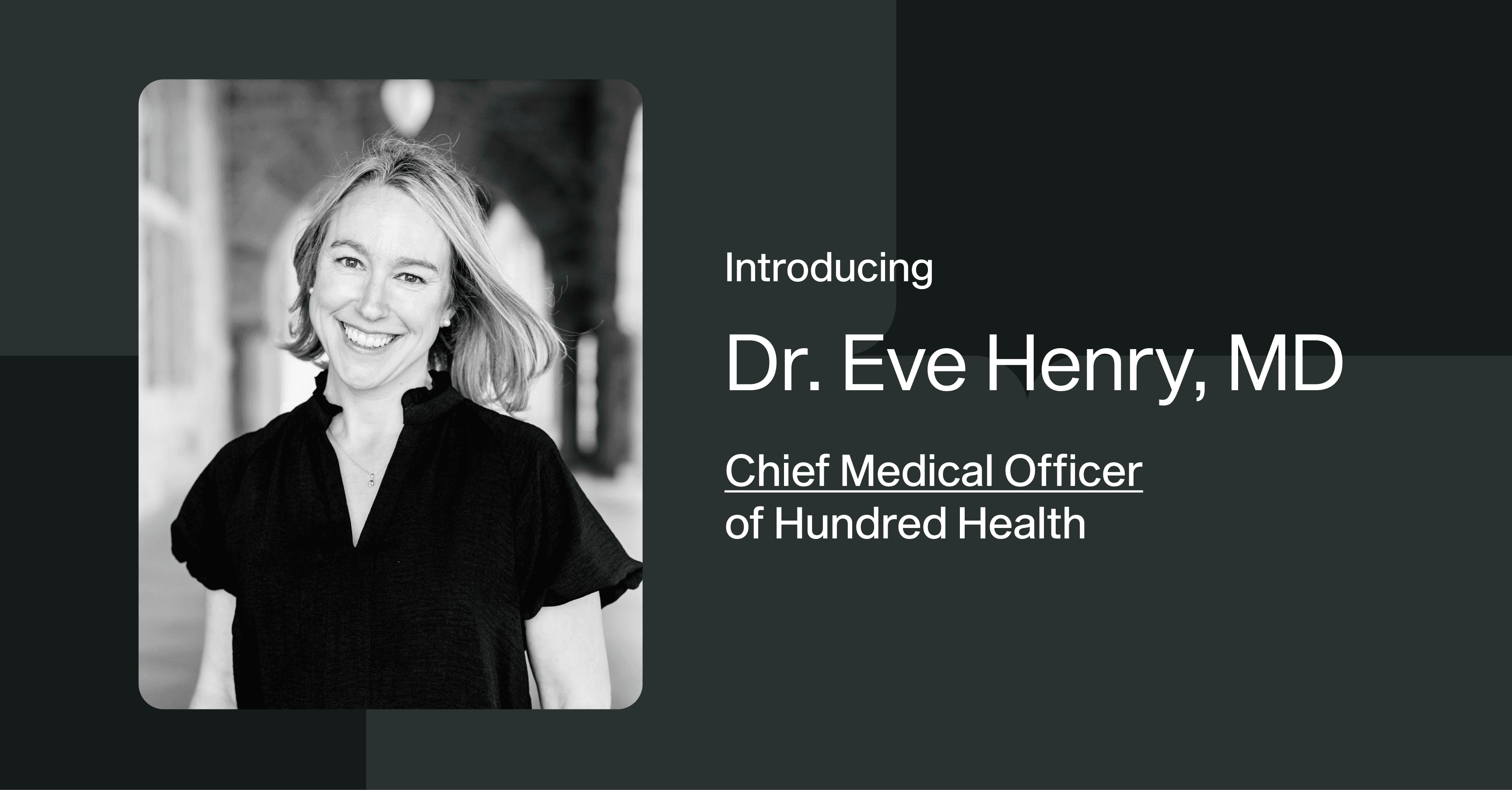
Trained at Princeton, Vanderbilt, and Stanford, Dr. Henry joins Hundred to help make personalized, precision care available to the masses — so we can live healthier lives doing what we love with who we love, for longer.

Hundred Team
Content
Subscribe for Updates
Share this Post
Welcome Dr. Eve Henry
We're so excited to welcome Dr. Eve Henry as Hundred Health's Chief Medical Officer. Dr. Henry brings a rare combination: elite clinical training, deep experience in longevity medicine, and a grounded understanding of what actually works when life gets messy.
Trained at Vanderbilt and Stanford, with advanced study at UCLA's Center for East-West Medicine and a fellowship at Dr. Andrew Weil's Center for Integrative Medicine, Dr. Henry most recently served as Medical Director of Early Medical — a highly exclusive concierge longevity clinic serving CEOs, elite athletes, and ultra-high-net-worth families.
That experience revealed something important: access to the best care isn't always the problem. Execution is. Even the most resourced patients struggled to turn data into sustainable health outcomes when faced with the realities of work, travel, and family life.
At Hundred, Dr. Henry is helping to make personalized, precision care accessible to the masses.
Get to Know Our CMO
You could choose to work with any organization. Why Hundred?
I've seen firsthand the power of understanding your biomarkers. When you know what's happening with your body, you can create educated action plans that will actually work for you. Many companies run biomarkers, but I was incredibly impressed by how Hundred focused on turning that information into knowledge — and then into action.
What did working inside elite longevity practices reveal about the limits of modern medicine?
Medicine can only do so much when the core tenets of health — sleep, nutrition, stress management — aren't well managed. I've worked with incredibly successful people with extremely high stress levels. People who travel most days of the year, never get enough sleep, and are constantly living in a state of fight or flight. No amount of supplements or testing can overcome the physiologic strain of that lifestyle. You can help buffer stress and minimize the damage, but it takes a toll.
Why do so many health plans fail even when people are highly motivated?
Health plans tend to fail if they're too complicated. Many times, the more motivated someone is, the more they want to do. Their new health plan involves 20 steps and 3 hours of daily effort — which they can only sustain for a short period of time. I tend to ask my clients to pick 3 things they want to work on. Nail down those 3 things as habits, then move on.
What is one behavior change that matters more than most supplements combined?
Getting enough sleep. It gives you the most dramatic results.
How do you think about health in the context of a busy, messy, imperfect life?
I try not to focus on perfection — instead, I focus on what can be done this week. I'm a busy mom with 3 elementary-aged kids. People often ask me if I make my food from scratch or work out twice a day, and honestly, that feels insane to me as I drive from a swim meet to baseball practice while eating almonds I stuck in the glove compartment.
Life has chapters. Someday I hope to have a chapter where I garden, do yoga in the morning, cardio after work, and relax in a sauna for 30 minutes before bed. But that's not this chapter. Instead, I focus on a strict bedtime for myself, calendaring my workouts at the start of the week, eliminating alcohol, and keeping sweets to (mostly) the weekends. It's not perfect, but it's good — which is the best I can do right now.
What would you redesign first if you were rebuilding healthcare from scratch?
I would shift the ownership of both the data and the action from healthcare providers to individuals. We grew up in a culture of passivity when it comes to our health. If you get sick, you have to wait, get testing and advice you may or may not understand, and then get given a solution. About 20-30% of prescriptions written by doctors are never even filled because the individual doesn't buy into or understand the action plan. There's so much power in understanding and ownership when it comes to our own health.
We're honored to have Dr. Henry is leading our medical vision as we build a new operating system for preventive care — one designed for real life.
Your annual physical tests 20 markers and sends you home. Hundred tests 100+, connects your wearables and medical history, and gives you a 100-day plan built from all of it. $0.55/day.
Cancel anytime · HSA/FSA eligible

