Longevity
•
8-min
In your 40s, cholesterol changes aren’t failure—they’re hormonal. This piece breaks down why “normal” labs miss the real story and which biomarkers actually matter to understand your cardiovascular risk.

Dr. Eve Henry
Chief Medical Officer

Subscribe for Updates
Share this Post
You went in for your annual physical. You did the bloodwork. Your doctor glanced at the results, said everything looked normal, and sent you home with a printout you probably filed somewhere and forgot about.
But something felt off. Your numbers were a little higher than last year. Nobody explained why. And "normal" — that word did a lot of work in a very short appointment.
Here's what I wish every woman in her 40s knew before she left that appointment.
What Estrogen Was Actually Doing for Your Cholesterol
For most of your 30s, estrogen was quietly running a cardiovascular protection operation you didn't even know existed.
Estrogen increases HDL — the cholesterol that clears debris from your arteries. It lowers LDL and triglycerides. It keeps arterial walls more flexible and less prone to inflammation. It's been doing this work in the background, reliably, for decades.
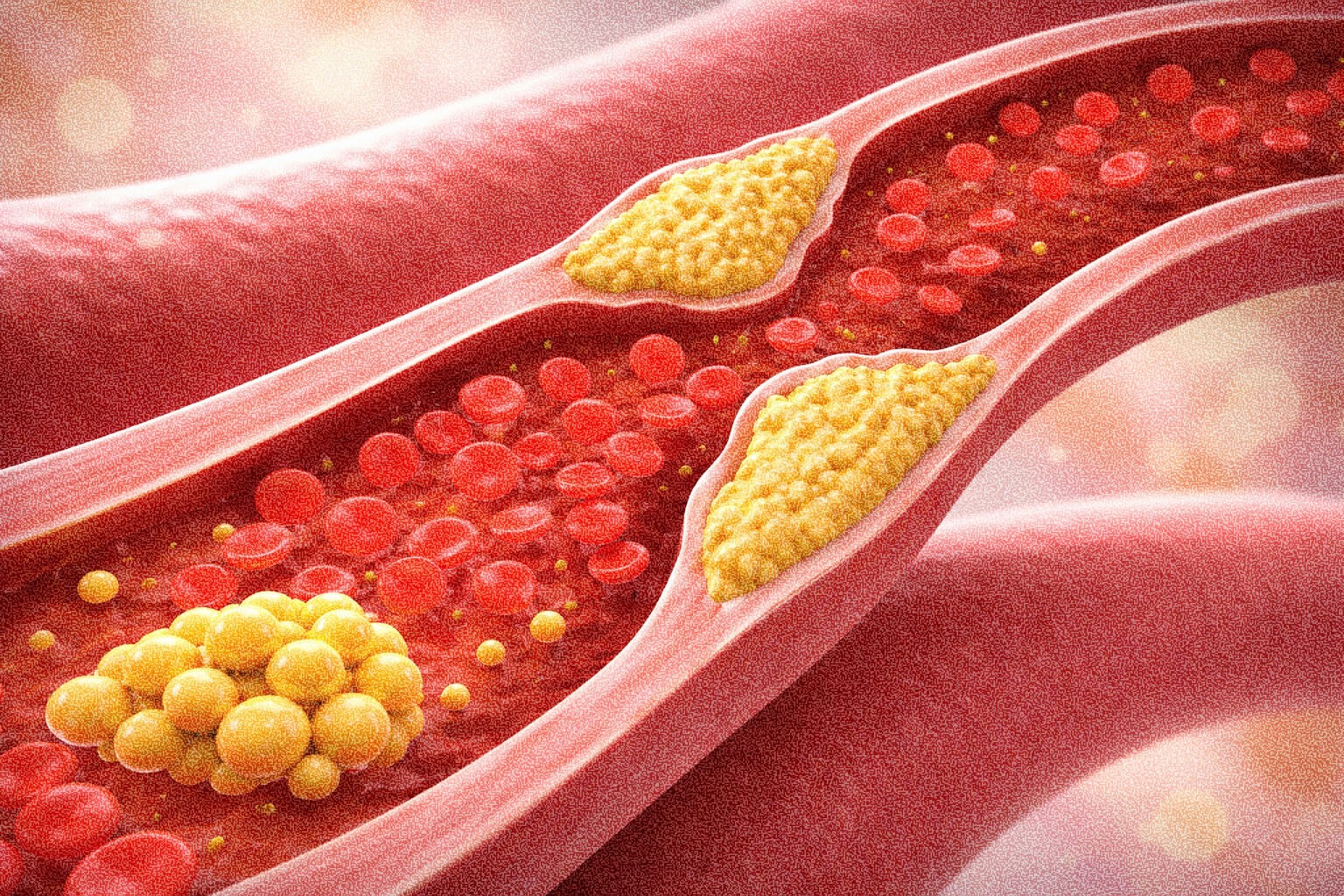
Think of estrogen as the cleanup crew that's been quietly scrubbing your arteries for 30 years. In perimenopause, that crew starts working fewer hours. The schmutz — the sticky, oxidized particles — starts accumulating faster than it's being cleared.
So when your LDL ticks up in your early 40s, or your HDL starts to drift down, that's not a personal failure. That's not evidence that you've been eating wrong or exercising too little. This is your body doing exactly what it's designed to do during this transition. The failure is that nobody told you it was coming.
I see women in my practice who've spent years blaming themselves for numbers that were always going to shift. They cut out eggs. They ran more. They tried every variation of a heart-healthy diet. And their cholesterol kept climbing anyway, because the mechanism driving it had nothing to do with their breakfast choices.
Once you understand what's actually happening hormonally, you can stop fighting the wrong battle — and start asking the right questions.
Why "Normal" Is the Wrong Standard
Here's something that doesn't get said enough in a standard fifteen-minute appointment: reference ranges are not the same as optimal ranges.
A reference range tells you where your number falls relative to the general population. If you're within range, you're average. That's it. It doesn't tell you whether you're protected. It doesn't tell you whether your cardiovascular risk is increasing. It doesn't account for the fact that you're a woman in perimenopause whose lipid metabolism is actively changing.
I tell my patients: a reference range tells you whether you're average. It doesn't tell you whether you're protected.
The standard lipid panel — total cholesterol, LDL, HDL, triglycerides — was largely developed and validated in male populations. It gives you a rough picture. But it misses the details that matter most for women in this decade of life, particularly around particle number, blood sugar, and inflammatory burden.
A woman can have an LDL that looks perfectly acceptable on a standard panel and still have a lipid profile that's quietly building cardiovascular risk. The number on the printout isn't lying to you — it's just not telling you the whole story.
Your 40s are the decade to get ahead of cardiovascular risk, not react to it. And getting ahead requires a more complete picture.
The Markers That Actually Matter
None of these are exotic. They're just not on the panel your doctor typically orders.
ApoB (Apolipoprotein B)
LDL is like counting the number of delivery trucks on the highway. ApoB counts the actual packages — the ones that can lodge in your artery wall. Each atherogenic particle carries one ApoB molecule, so ApoB gives you a direct count of the particles that drive plaque formation. The evidence here is strong — cardiovascular societies are increasingly recommending ApoB over standard LDL as the more precise risk marker.
Lp(a) — Lipoprotein(a)
This is the sticky-handed version of LDL — it grabs onto artery walls and doesn't let go. Lp(a) is largely genetic. Diet won't change it. Exercise won't change it. If you have elevated Lp(a), you need to know, because it significantly increases cardiovascular risk and changes how aggressively you should address your other modifiable factors. Most people have never been tested. The evidence for Lp(a) as a risk marker is strong; treatment options are still emerging — but knowing your number is the first step.
Fasting Insulin, HbA1c, and HOMA-IR
Insulin resistance accelerates during perimenopause and directly amplifies cardiovascular risk, independent of cholesterol. Fasting insulin gives you a real-time snapshot of how hard your pancreas is working. HbA1c tells you the longer story — your average blood sugar over the past two to three months, which is often more revealing than a single fasting number. Neither is routinely included in a standard panel. The mechanistic link between insulin resistance and cardiovascular risk is strong; guidance on optimal ranges is still evolving, which is exactly why tracking both over time matters more than any single result.
hsCRP (High-Sensitivity C-Reactive Protein)
Inflammation is the fire. Cholesterol is often just the fuel. You need to know if the fire is burning. hsCRP predicts cardiovascular events independently of cholesterol levels. It's inexpensive, widely available, and often not part of an annual physical.
What You Can Do Right Now
Three things. Start here.
1. Ask for the right tests at your next appointment.
Request ApoB, Lp(a), fasting insulin, HbA1c, and hsCRP by name. Lp(a) only needs to be tested once — it's genetic and won't change. ApoB, hsCRP, fasting insulin, and HbA1c are worth tracking every six to twelve months during this transition.
2. Understand your numbers in context, not in isolation.
A single elevated marker means less than the pattern across markers over time. Your 40s are the decade to establish your personal baseline — not to wait for a problem to appear. Ownership of your data is the first step toward longevity. You can't optimize what you can't see.
3. Address the modifiable drivers with what actually works.
Both aerobic exercise and resistance training improve your lipid picture during perimenopause — and they do it through different mechanisms, which is exactly why doing both matters.
Aerobic exercise is your strongest lever for raising HDL and lowering triglycerides. Resistance training earns its place through insulin sensitivity, muscle preservation, and metabolic health — which in perimenopause is doing a lot of heavy lifting. Programs that combine both consistently outperform either alone.
So the answer isn't cardio versus weights. It's cardio and weights.
Sleep quality directly impacts both. The evidence for specific dietary interventions in perimenopausal women is still evolving, but the case for moving your body — in multiple ways — is solid.
This is exactly the kind of comprehensive biomarker picture that Hundred Health's protocols are built around — not a one-time snapshot, but a pattern over time that shows you what's changing, what's driving it, and what to do about it. It's the conversation your doctor should have started.
You Have More Control Than You Think
Back to the woman leaving her appointment with a "normal" printout.
She's not wrong to feel unsatisfied. She was handed an incomplete picture. But now she has the vocabulary, the specific markers, and the questions to go back and have a completely different conversation.
Your cardiovascular trajectory in your 40s is more modifiable than at almost any other point in your life. The hormonal shifts are real, and they matter — but they don't determine the outcome. What you do with the information does.
The data is there. You just need someone to help you read it.

Dr. Eve Henry is an internal medicine physician and Chief Medical Officer at Hundred Health. Hundred Health's comprehensive biomarker panel includes ApoB, Lp(a), fasting insulin, HbA1c, hsCRP, and 40+ additional markers — with personalized protocols updated every 100 days based on your results.
Your annual physical tests 20 markers and sends you home. Hundred tests 100+, connects your wearables and medical history, and gives you a 100-day plan built from all of it. $0.55/day.
Cancel anytime · HSA/FSA eligible

